A Pennsylvania road trip does not have to mean spending most of the day behind the wheel. By choosing one regional base, limiting the number of major stops, and planning each day around a single priority, you can leave time for trails, historic sites, downtown walks, meals, and unplanned discoveries.
This approach works especially well for families, couples, older travelers, and anyone who prefers a flexible itinerary.
The goal is not to cover the greatest distance. It is to make each stop feel worth the drive.
What counts as a short driving day?
For most travelers, a short driving day means approximately two to three hours of total driving, divided into manageable segments. A practical target is 45 to 75 minutes between stops, although traffic, road construction, weather, and scenic detours can change the actual time.
Instead of treating that limit as a strict deadline, use it as a planning filter. If a proposed day requires several long transfers, multiple timed reservations, and a late return, it probably needs to be simplified.
A useful daily rhythm
- Morning: Drive to the day’s main destination while energy is high.
- Late morning and early afternoon: Explore one primary attraction or district.
- Afternoon: Add one optional stop close to the return route.
- Evening: Return before fatigue, darkness, or dinner-hour traffic becomes a concern.
This structure provides enough direction to prevent wasted time without turning the trip into a rigid schedule.
Choose a regional base instead of changing hotels daily
Short driving days are easier to build when you stay in one place for two or more nights. A fixed regional base removes repeated packing, check-in, and check-out time while allowing you to choose each day’s route according to the weather and your energy level.
South Central Pennsylvania is particularly suited to this hub-and-spoke approach. From a base in the Harrisburg or Lewisberry area, travelers can plan separate outings toward Gettysburg, York, Lancaster County, Hershey, the Susquehanna River, or nearby parks without combining every destination into one exhausting loop.
A quieter itinerary can begin with Lewisberry as a Pennsylvania retreat. A low-mileage arrival or departure day can also include a day in Lewisberry.
Use a realistic planning radius
Begin with destinations that appear to be within roughly 60 to 75 minutes of your base under normal conditions. Treat map estimates as preliminary rather than guaranteed. Check the route again shortly before departure, accounting for construction, special events, winter conditions, and peak traffic.
A destination near the edge of the radius should normally be the day’s only major outing. Closer places can be paired, but only when they lie naturally along the same route.
The farther the anchor destination is from your base, the fewer additional stops the day should include.
Build each day around one anchor experience
An anchor experience is the activity that would make the day satisfying even if every optional stop were removed. It might be a battlefield visit, a state park walk, a museum, a downtown neighborhood, or a scenic drive.
Once the anchor is chosen, add no more than two supporting stops:
- A practical stop, such as lunch, fuel, or a grocery pickup.
- An optional stop, such as an overlook, café, short trail, or local shop.
The optional stop should be easy to skip without disrupting the rest of the day. That decision creates valuable flexibility when an attraction takes longer than expected or someone in the group needs a break.
Avoid the zigzag effect
Several nearby attractions can still produce a tiring day if they sit in different directions. Plot the base, anchor, meal stop, and optional activity before finalizing the plan. Favor a compact loop or a simple out-and-back route over a day that repeatedly crosses the same region.
For example, a Gettysburg-focused day should remain centered on Gettysburg rather than adding Lancaster or Hershey simply because both are on the broader vacation list. A focused route can follow the principles used for a Gettysburg day trip from the Harrisburg area.
The same rule applies to a Lancaster County day trip or a day in Hershey: choose a central experience and avoid unrelated detours.
A sample Pennsylvania itinerary with limited wheel time
The following framework assumes a base in South Central Pennsylvania. Driving ranges are planning targets, not live travel estimates. Confirm current routes, opening hours, parking rules, and conditions before leaving.
| Day | Main focus | Suggested structure | Driving target |
|---|---|---|---|
| 1 | Arrival and local orientation | Check in, take a short local walk, and have dinner nearby. | Under 1 hour after arrival |
| 2 | Nature | Choose one park, one trail area, and a flexible picnic or meal stop. | About 1–2 hours total |
| 3 | Gettysburg | Devote the day to the historic area and remove unrelated detours. | About 2–3 hours total |
| 4 | York or Harrisburg | Pick one walkable district, allow time for lunch, and return early. | About 1–2 hours total |
| 5 | Departure | Add only a stop that lies directly along the route home. | Depends on onward route |
A nature day can center on Gifford Pinchot State Park. Urban alternatives include the Harrisburg riverfront and downtown York on foot.
Plan by time blocks, not by attraction count
A list of six attractions may look manageable on a map, but it ignores parking, meals, restrooms, ticket lines, and the time needed to enjoy each place. Time blocks produce a more realistic itinerary.
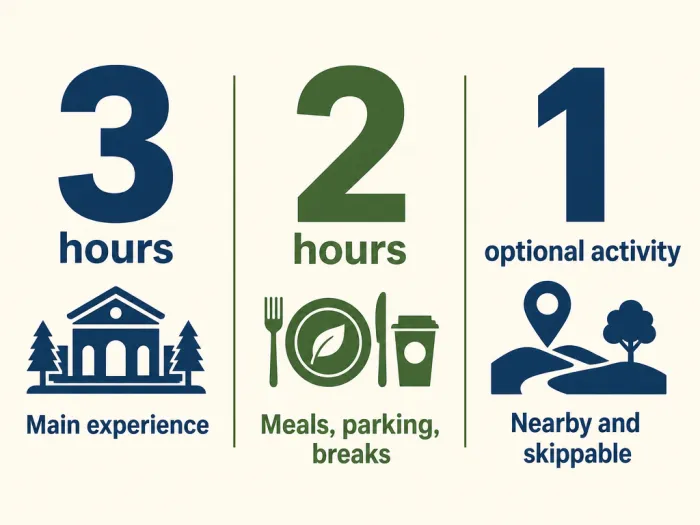
The 3-2-1 planning method
- Three hours: Reserve a substantial block for the main experience.
- Two hours: Allow for meals, parking, transitions, and breaks.
- One optional activity: Keep one nearby stop available if time and energy permit.
You do not need to fill every minute. An open hour can absorb traffic or become time for a longer lunch, an unexpected shop, or a scenic pause.
Set a turnaround time
Decide in advance when to begin the return trip. A fixed turnaround time is especially helpful during winter, when daylight is limited, and during summer weekends, when popular areas may be busier than expected.
If the itinerary falls behind, remove the optional stop rather than driving faster or cutting the anchor experience short.
Make the itinerary flexible for weather and seasons
Pennsylvania driving conditions can vary by season and elevation. Heavy rain may reduce visibility, winter weather can affect untreated roads, and fall weekends may bring additional traffic to scenic areas. Build a backup plan that remains in the same general direction as the original outing.
- Rain: Replace a long trail with a museum, covered market, café, or compact downtown visit.
- Heat: Drive earlier, choose shaded or indoor activities, and schedule the longest break in mid-afternoon.
- Winter: Reduce the radius, avoid unnecessary back roads, and return before dark when conditions are uncertain.
- Busy fall weekends: Start early and avoid stacking several scenic areas into one day.
Seasonal alternatives include a rainy-day Pennsylvania road trip, a flexible Pennsylvania winter itinerary, and Pennsylvania fall road-trip planning.
Before departure, check current forecasts, official attraction notices, and live road information. Do not rely solely on a saved map or an itinerary prepared several days earlier.
Short-driving-day checklist
- Choose one accommodation base for at least two nights.
- Set a target of no more than two to three total driving hours per day.
- Select one anchor experience for each outing.
- Keep most driving segments under approximately 75 minutes.
- Add only one optional sightseeing stop.
- Group stops that lie along the same corridor.
- Allow time for parking, meals, restrooms, and unexpected delays.
- Set a turnaround time before leaving in the morning.
- Prepare an indoor or lower-mileage weather alternative.
- Download or print essential directions where reception may be unreliable.
- Check fuel or charging needs before entering rural areas.
- Confirm live road conditions and same-day opening information.
A Pennsylvania road-trip packing checklist can help organize essential vehicle and day-trip gear.
Common planning mistakes to avoid
Counting only nonstop driving time
A route labeled as two hours on a map can occupy much more of the day after parking searches, fuel stops, roadwork, and traffic are included. Add a time buffer instead of scheduling activities immediately after the predicted arrival time.
Changing accommodations too often
A one-night stay may appear efficient, but repeated packing and check-in tasks reduce the time available for sightseeing. Staying put often creates a calmer trip even when it means retracing part of a route.
Treating every stop as mandatory
An itinerary needs an order of importance. Label stops as essential, optional, or only-if-convenient. This makes decisions easier when the day changes.
Using scenic roads as shortcuts
Scenic routes are valuable when the drive itself is the activity. They are less suitable when you need to reach a timed reservation. Allow extra time for slower roads, overlooks, and photo stops rather than assuming the scenic option will match the direct route.
A route built around Pennsylvania covered bridges should therefore treat the drive as the anchor experience, not as a shortcut between unrelated attractions.
Mini FAQ
How many destinations should I visit in one day?
Plan one primary destination and, at most, one or two supporting stops nearby. A meal stop does not need to become another major sightseeing commitment.
Is two hours of driving per day enough for a Pennsylvania trip?
Yes, if you choose a regional base and explore one area at a time. Some destination days may approach three hours of total driving, while arrival, departure, and local days can remain much shorter.
Should I book timed attractions in advance?
Advance booking can be useful when an attraction requires reservations or has limited capacity. Avoid placing several timed bookings in different locations on the same day because one delay can affect the entire itinerary.
How do I plan for travelers with different energy levels?
Choose an anchor activity that everyone can enjoy, schedule regular seated breaks, and keep the optional stop genuinely optional. A central base also allows one traveler to rest without requiring the whole group to relocate.
What should I do if the weather changes?
Keep a same-region backup rather than driving across Pennsylvania in search of better conditions. Replace an outdoor activity with a nearby indoor stop, shorten the day, or move the anchor outing to another date.
Can a scenic drive fit into a low-mileage itinerary?
Yes. Treat the scenic route as the main experience rather than transportation between several attractions. Select a defined turnaround point and leave room for unplanned stops.