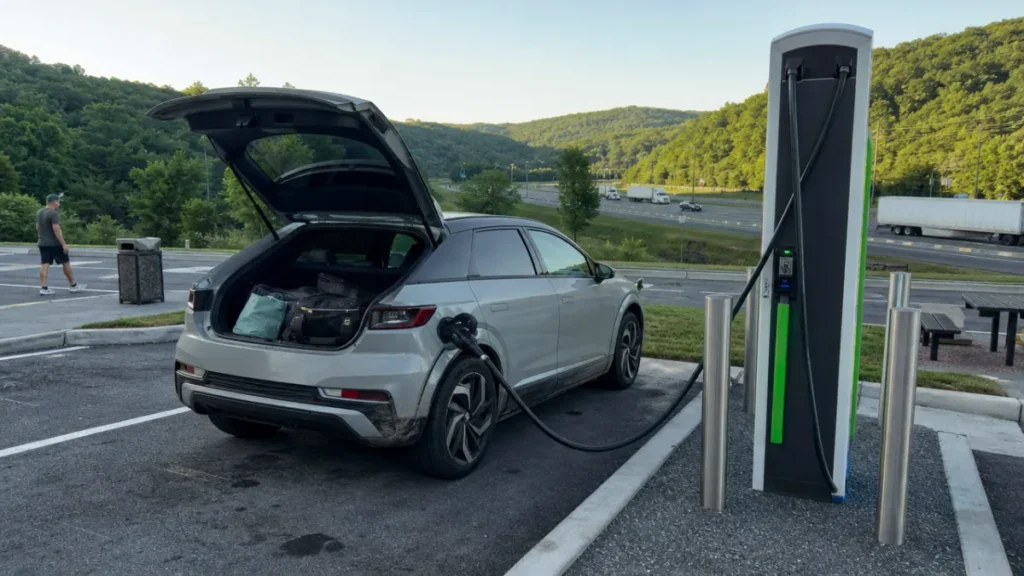
Planning a Pennsylvania road trip in an electric car is less about finding one perfect charging stop and more about building a route with options. Distances, mountain grades, cold weather, traffic, and charger availability can all affect the plan.
The practical approach is simple: understand your vehicle, identify dependable charging areas, keep a backup for each important stop, and confirm live conditions shortly before departure.
A dependable EV itinerary includes a realistic range estimate, compatible chargers, and a reachable backup for every essential stop.
Start with your electric car’s real travel range
Do not build the itinerary around the range displayed when the battery is full. That estimate can change with speed, temperature, elevation, wind, climate control, and the weight of passengers or luggage.
Your recent highway efficiency is usually a more useful planning reference. A basic estimate is:
Usable battery capacity × expected efficiency = theoretical driving range
For example, a car with 70 kWh available and an expected efficiency of 3 miles per kWh has a theoretical range of about 210 miles. That does not mean you should schedule charging exactly 210 miles apart. A practical itinerary leaves a battery reserve for detours, unavailable chargers, congestion, and unexpected energy use.
Know your charging curve
The maximum charging speed in a brochure tells only part of the story. Many electric vehicles charge fastest at a low state of charge and slow considerably as the battery fills. On a travel day, a shorter session followed by another well-placed stop may take less time than waiting for the battery to reach 100%.
Before leaving, identify:
- Your vehicle’s usable highway range in mild and cold conditions.
- Its maximum AC and DC charging rates.
- The battery level at which rapid charging begins to slow noticeably.
- Whether battery preconditioning starts automatically when navigating to a charger.
- Which connector and approved adapters your vehicle can use.
Match the charger to your vehicle
Connector compatibility is particularly important while North American charging networks and manufacturers transition between standards. Never assume that a station is compatible merely because it appears along the route.
| Charging option | Typical use | What to verify |
|---|---|---|
| Level 1 AC | Emergency or long overnight charging | Outlet permission, circuit condition, cable reach, and charging time |
| Level 2 AC | Hotels, downtown stops, attractions, and overnight stays | J1772 or NACS compatibility, access hours, fees, and parking rules |
| CCS rapid charging | Travel stops for compatible vehicles | Power, live status, number of working plugs, and payment method |
| NACS rapid charging | Compatible vehicles and approved adapter users | Whether that specific station is open to your vehicle model |
An adapter does not automatically make every charger usable. Confirm support in the vehicle manufacturer’s app or the charging network’s current listing. If an adapter is required, use equipment approved for your vehicle and charging situation.
Build the Pennsylvania route around charging areas
Major corridors such as I-76, I-78, I-80, I-81, and I-83 provide a useful framework for crossing Pennsylvania, but the best route is not always the shortest one. A slightly longer route can be easier if it offers several charging locations, food, restrooms, and an alternative station nearby.
Use an EV route planner to create the first draft, then check each proposed stop independently. Charging data can change, so review live station information on the day of travel rather than relying on an old screenshot or saved itinerary.
Choose stops with reachable backups
For every essential charging stop, identify a second option that you can reach with a safe battery reserve. A backup located beyond the primary charger is not useful if the car cannot comfortably reach it.
Your backup charger must be reachable with the energy remaining when the primary station becomes unavailable.
For each planned stop, record:
- The network and street address.
- The connector type and advertised power.
- The number of available plugs.
- Recent driver reports, when available.
- Access hours, parking restrictions, and possible fees.
- A reachable backup station.
- Food, restrooms, or a walking area nearby.
Plan overnight charging carefully
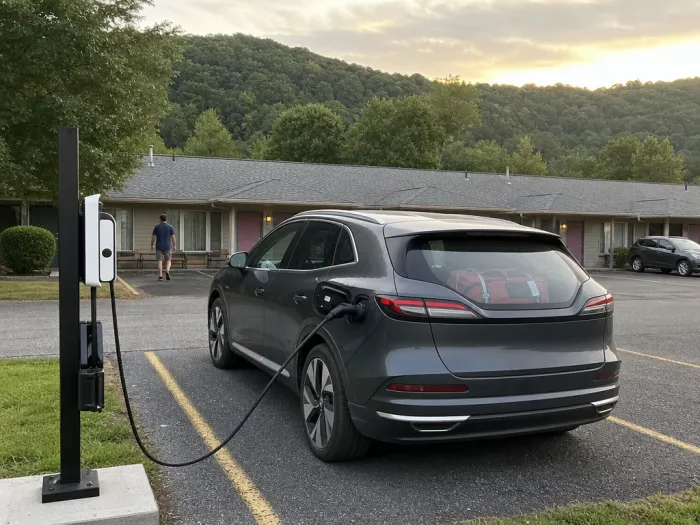
Destination charging can remove a rapid-charging stop from the next day, but only if access is dependable. Ask the accommodation whether charging is available to overnight guests, whether it can be reserved, what connector is installed, and whether a separate fee applies.
If the property offers only a standard outlet, ask permission before using it. Do not assume an outdoor receptacle is suitable for continuous vehicle charging. Bring the correct mobile charging equipment, but rely on an ordinary outlet only when the property has approved its use.
Account for Pennsylvania terrain and weather
Pennsylvania combines busy urban approaches, rolling countryside, long highway segments, and mountain crossings. These conditions can produce very different levels of energy consumption over the course of one trip.
Elevation and highway speed
Long climbs increase energy use. Descents can recover some energy through regenerative braking, but they do not normally return everything consumed on the climb. Sustained high speed also reduces efficiency, so leave additional margin when a leg combines highway travel with elevation changes.
Cold, heat, and rain
Cold batteries may charge more slowly, while cabin heating can increase consumption. In hot weather, air conditioning and battery cooling also use energy. Heavy rain, standing water, and strong wind can further reduce efficiency.
For a cold-season journey, use a more conservative arrival target and adapt the route with a Pennsylvania winter road-trip itinerary. If the forecast is unsettled, a rainy-day Pennsylvania road trip can help keep the schedule flexible.
Traffic and closures
Congestion may lower energy use at slow speeds, but it can add hours of heating or cooling and disrupt charger arrival times. Construction, crashes, and severe weather can also force a significant detour. Check current traffic, construction, weather, and road closures before departure and again during longer stops.
Use a repeatable EV planning workflow
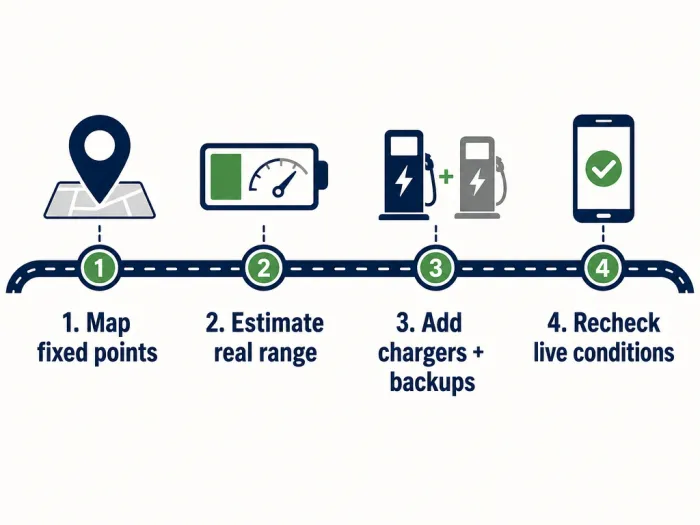
A reliable EV road-trip itinerary can be created in a few passes. Avoid attempting to solve the route, meals, attractions, and charging in one step.
- Map the fixed points. Enter the starting point, overnight destination, timed reservations, and final destination.
- Estimate each driving leg. Use your vehicle’s realistic highway efficiency rather than its most optimistic displayed range.
- Add primary chargers. Favor locations that fit natural breaks for meals, restrooms, or short walks.
- Add reachable backups. Confirm that the alternative can be reached if the primary site is unavailable.
- Review arrival margins. Increase the reserve for cold weather, mountains, rural detours, or unfamiliar roads.
- Check access details. Look for restricted parking, business hours, tolls, garage access, and network requirements.
- Recheck the route. Review weather, traffic, and live charger status shortly before leaving.
Example of a flexible regional itinerary
For a trip based in south-central Pennsylvania, destinations such as Harrisburg, Hershey, Gettysburg, and nearby parks can be separated into individual day trips. This makes it easier to return to overnight charging instead of depending on several rapid-charging sessions in one day.
| Trip type | Charging approach | Useful precaution |
|---|---|---|
| Short local day trip | Begin with enough charge to complete the outing | Save one local charger as a backup |
| Full-day regional trip | Combine an attraction with a Level 2 or rapid-charging stop | Confirm that parking duration matches charging time |
| Cross-state journey | Plan several short sessions along major corridors | Keep a reachable alternative for every essential stop |
| Winter or mountain route | Charge earlier and maintain a larger reserve | Recalculate after weather or route changes |
Regional options include a Gettysburg day trip from the Harrisburg area, a Harrisburg riverfront day trip, and a Hershey day visit beyond the theme park. Verify current charging options separately when adapting any destination itinerary to an electric vehicle.
Prepare apps, payments, and roadside backups
Charging networks do not all use the same payment process. Install the relevant apps before leaving, create accounts, and confirm that your payment card works. Keep a physical payment card available because mobile service may be weak or an app may fail.
Use your vehicle navigation and charging-network apps to identify stations, confirm compatibility, and review current availability. Download offline maps for rural or mountainous areas. Save charger street addresses rather than relying exclusively on map pins, which can occasionally lead to the wrong entrance or parking area.
What to carry
- Approved mobile charging cable and compatible adapters.
- Charging-network apps with accounts already activated.
- A physical credit card and saved network support numbers.
- Offline maps and screenshots of backup stations.
- A phone cable and charged power bank.
- Tire inflator, pressure gauge, warning triangle, and basic roadside kit.
- Water, snacks, suitable clothing, and any essential medication.
- An ice scraper, blanket, and gloves during cold-weather travel.
The Pennsylvania road-trip packing checklist covers broader vehicle and personal essentials. A road-trip power bank can also support navigation and charging apps throughout the day.
EV road-trip checklist before departure
- Charge to the level recommended for the planned departure.
- Check tire pressures when the tires are cold.
- Enter the first rapid charger in the vehicle navigation if this enables battery preconditioning.
- Verify the primary and backup chargers for every long leg.
- Confirm connector compatibility and adapter requirements.
- Check charging-network accounts and payment methods.
- Review weather, construction, traffic, and road closures.
- Download offline maps and save charger addresses.
- Confirm overnight charging directly with the accommodation.
- Tell another person about remote or late-night travel plans.
- Recalculate the next leg if consumption is higher than expected.
If actual energy consumption is higher than planned, reduce the distance to the next stop and charge earlier rather than using the battery’s final miles.
Mini FAQ
How much battery should remain when I reach a charger?
There is no single target for every trip. Many drivers plan to arrive with a moderate reserve rather than using the battery’s final miles. Increase that reserve in cold weather, on mountain routes, in remote areas, or when the next charger has no nearby alternative.
Should I charge to 100% at every stop?
Usually not. Rapid charging often slows as the battery fills, so charging only enough to reach the next reliable stop can save time. A higher charge may still be appropriate before a long gap, in poor weather, or when charging overnight. Follow the vehicle manufacturer’s battery guidance.
Can I depend on chargers at Pennsylvania Turnpike service plazas?
Charging locations, access, compatibility, and operating status can change. Treat a service-plaza charger as a planned stop only after checking its current network listing, and retain a reachable alternative whenever possible.
Do I need multiple charging apps?
Possibly. The required apps depend on your vehicle, connector, and route. Install and test the networks shown on your itinerary before departure instead of creating accounts beside the charger.
What should I do if a charger is broken?
Try another compatible plug at the same location, follow the network’s troubleshooting instructions, and contact its support team if necessary. If the station remains unavailable, use the backup selected before departure. Do not continue toward a distant charger unless the vehicle has a comfortable energy margin.
Is an EV suitable for a Pennsylvania winter road trip?
It can be, provided the route accounts for lower efficiency, slower charging when the battery is cold, weather-related delays, and limited alternatives in some areas. Start with a conditioned battery when possible, charge earlier than usual, and keep the itinerary flexible.